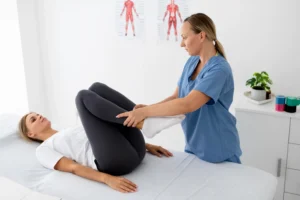

Hip pain while walking can make daily activities such as climbing stairs, standing, exercising, or getting in and out of a car uncomfortable. The pain may be felt in the groin, outer hip, buttock, thigh, or sometimes even around the knee.
Walking-related hip pain can have several causes, including arthritis, muscle or tendon problems, bursitis, injuries, and conditions affecting the lower back. The location, severity, and timing of pain can provide useful clues, but an accurate diagnosis requires a medical evaluation.
This complete guide explains the common causes of hip pain while walking, warning symptoms, treatment options, prevention tips, and signs that may indicate the need for hip replacement.
Understanding Hip Pain While Walking
Walking is one of the most natural human movements — and the hip joint is central to making it happen. The hip bears 3-5 times your body weight with every walking step, coordinating input from the femoral head and acetabulum, multiple muscle groups, tendons, bursae, and the lumbar spine to produce smooth, pain-free gait.
When hip pain develops during walking, it is the joint’s way of signalling that something within this complex system is under excessive stress, affected, or inflamed. The exact location of the pain — groin, outer hip, buttock, or radiating into the thigh — is one of the most clinically useful indicators of which specific structure is the source.
Hip pain while walking that starts mild and occasional but becomes consistent and limiting is not something to manage indefinitely. Early evaluation produces better treatment outcomes across virtually every cause.
Who Is Most at Risk for Hip Pain When Walking?
Hip pain while walking affects a wide age range — but certain groups carry significantly higher risk:
- Adults over 50 — age-related cartilage degeneration and osteoarthritis are the leading causes of hip pain during walking in this group
- Women — wider pelvis and greater Q-angle create different mechanical loads on the hip; trochanteric bursitis is significantly more common in women
- Overweight and obese individuals — every extra kilogram adds 3-5 times the force through the hip joint during walking
- Athletes and distance runners — IT band syndrome, labral tears, and stress fractures from repetitive high-load walking and running
- People with sedentary lifestyles — hip flexor tightness, gluteal weakness, and reduced joint mobility increase pain risk when activity is suddenly increased
- Patients with diabetes or osteoporosis — elevated risk of avascular necrosis and stress fractures presenting as hip pain during walking
5 Major Causes of Hip Pain While Walking
Cause 1 — Hip Osteoarthritis
Hip osteoarthritis is the most common cause of progressive hip pain while walking in adults over 50. It develops as the articular cartilage within the hip joint gradually wears away — eventually leading to bone-on-bone contact that produces deep, aching groin and anterior hip pain that worsens consistently with walking distance.
Characteristic symptoms:
- Deep groin or anterior hip pain that worsens with prolonged walking
- Morning stiffness lasting 15-30 minutes before the hip loosens up
- Pain that improves after the first few minutes of walking, then worsens again as distance increases
- Crepitus — a grinding or clicking sensation within the hip joint
- Progressive reduction in hip rotation range of motion
Why it worsens with walking: Every walking step compresses the degenerating joint surfaces — with more symptoms as walking distance increases and cartilage protection diminishes.
Cause 2 — Trochanteric Bursitis (Greater Trochanteric Pain Syndrome)
The trochanteric bursa is a small fluid-filled sac over the bony part on the outer side of the hip. When it becomes inflamed, it can cause pain on the outside of the hip, especially while walking or lying on the affected side. It is more common in women and people with weak hip muscles.
Characteristic symptoms:
- Burning or aching pain on the outer side of the hip
- Pain that worsens with prolonged walking, stair climbing, and rising from a chair
- Tenderness on direct pressure over the outer hip bone
- Nighttime pain when lying on the affected side — often disrupting sleep
Why it worsens with walking: The gluteal tendons and IT band repeatedly pass over the inflamed bursa during the walking gait cycle — each step increasing friction and pain.
Cause 3 — Hip Labral Tear
The hip labrum is a ring of strong tissue that helps support and stabilize the hip joint. A tear can happen due to repeated hip strain, sports, or certain hip problems. It usually causes pain in the front of the hip or groin, which may get worse with walking or standing for long periods.
Characteristic symptoms:
- Deep anterior hip pain or groin pain — often described as pain inside the hip crease
- A clicking, catching, or locking sensation in the hip during walking
- Pain that worsens after walking and improves with rest
- Stiffness after sitting that becomes painful on initial standing and walking
- Common in active adults aged 20-45, particularly runners and dancers
Cause 4 — Muscle Weakness and Hip Flexor Tightness
One of the most common but least recognised causes of hip pain while walking is a functional problem rather than a structural one — weakness in the hip abductors (particularly the gluteus medius) and tightness in the hip flexors (iliopsoas) that alters gait mechanics and places abnormal load on the hip joint and surrounding structures.
Characteristic symptoms:
- Lateral hip aching that develops after a predictable walking distance
- A Trendelenburg gait — the pelvis drops to the opposite side with each step, visible as a slight waddle
- Tightness in the front of the hip at the start of walking that improves as the muscles warm up
- Pain that is exercise-related rather than present at rest
- No clear structural findings on early imaging — diagnosis is clinical
Why this matters: Gluteal weakness and hip flexor tightness are both identifiable and highly treatable with targeted physiotherapy — making this one of the most reversible causes of hip pain while walking.
Cause 5 — Referred Pain from the Lumbar Spine
Not all hip pain while walking originates from the hip itself. The lumbar spine — particularly the L2, L3, L4, and L5 nerve roots — refers pain into the groin, hip, buttock, and thigh. Lumbar disc herniation, facet joint arthritis, and lumbar spinal stenosis can all produce pain perceived as hip pain during walking.
Characteristic symptoms of lumbar-referred hip pain:
- Pain that radiates from the lower back through the buttock and into the hip or thigh
- Neurogenic claudication — pain with walking that is relieved by sitting or bending forward (characteristic of spinal stenosis)
- Numbness, tingling, or weakness in the leg alongside hip pain
- Hip range of motion preserved — the hip itself moves freely without reproduction of pain
- Back pain present alongside or preceding the hip pain
Clinical distinction: If hip pain while walking is reproduced by lumbar flexion and extension rather than hip rotation, the source is likely spinal rather than hip joint.
Warning Symptoms of Hip Pain While Walking
Most hip pain while walking is caused by the conditions above and responds well to treatment. However, some symptoms signal more serious underlying causes requiring urgent assessment:
Seek same-day or next-day evaluation if you notice:
- Sudden severe hip pain after a fall — particularly in older adults with osteoporosis; possible hip fracture
- Complete inability to weight-bear after a hip injury
- Hip pain with fever and feeling systemically unwell — possible septic arthritis (joint infection)
- Rapid worsening of pain over days rather than gradual onset over weeks
Seek prompt (within 1-2 weeks) specialist evaluation if:
- Hip pain while walking has been constant beyond 4-6 weeks without improvement
- Neurological symptoms — numbness, tingling, or leg weakness — accompany the hip pain
- Pain is consistently limiting walking to less than a comfortable daily distance
- Hip pain wakes you from sleep regularly
How Do You Know If Your Hip Pain Is Serious?
Hip pain while walking that requires specialist attention has specific distinguishing features:
- Rest pain — pain present even when not walking or weight-bearing suggests inflammatory arthritis, infection, or bone pathology
- Night pain — consistent pain disturbing sleep without a clear positional explanation
- Progressive neurological symptoms — weakness or numbness worsening over weeks
- Constitutional symptoms — unexplained weight loss, fever, or fatigue alongside hip pain
- History of cancer — hip pain in a known cancer patient requires urgent investigation for bone metastasis
Treatment Options for Hip Pain While Walking
Treatment is determined by the specific cause — but the following approaches are broadly effective across most causes:
Physiotherapy — The Most Effective First-Line Treatment
Targeted physiotherapy addresses the root biomechanical cause of most hip pain while walking:
- Gluteal and hip abductor strengthening — clamshells, side-lying hip abduction, single-leg stance exercises
- Hip flexor stretching — kneeling lunge stretch, Thomas stretch for iliopsoas tightness
- Gait retraining — correcting Trendelenburg patterns and foot strike mechanics
- Neural mobilisation — for lumbar-referred hip pain with sciatic component
Medications for Hip Pain While Walking
- NSAIDs — for acute inflammation in bursitis, osteoarthritis flare-ups, and labral tears
- Topical anti-inflammatories — for outer hip pain from trochanteric bursitis where systemic medication is not preferred
Corticosteroid Injections
- Intra-articular hip injection — for osteoarthritis flare-ups producing severe walking pain
- Trochanteric bursa injection — highly effective for constant trochanteric bursitis
- Lumbar epidural — for spinal stenosis or disc herniation causing referred hip pain
Surgical Treatment (When Required)
- Hip arthroscopy — for confirmed labral tears and femoroacetabular impingement
- Total hip replacement — for end-stage hip osteoarthritis producing severe, functional limitation during walking
- Lumbar decompression or microdiscectomy — for confirmed spinal stenosis or disc herniation causing neurogenic hip pain
How to Prevent Hip Pain While Walking
Prevention is more straightforward than treatment for most causes:
- Maintain a healthy body weight — reduces compressive load through the hip joint on every walking step
- Warm up before walking — particularly before longer distances; 5 minutes of hip circles, leg swings, and quad stretches prepares the joint
- Strengthen the gluteus medius consistently — the most important preventive muscle for hip walking pain
- Wear appropriate footwear — supportive, well-cushioned shoes reduce ground reaction force transmitted to the hip
- Progress walking distance gradually — increasing mileage by no more than 10% per week prevents overuse injuries
- Stretch hip flexors daily — particularly for desk workers who sit for prolonged periods before walking
- Address lumbar spine health — core strengthening and posture correction protect the nerve roots whose irritation refers as hip pain
What Are the Signs That You May Need a Hip Replacement?
For patients with confirmed hip osteoarthritis, these indicators suggest that conservative management is no longer sufficient and total hip replacement deserves serious consideration:
- Constant hip pain while walking despite consistent physiotherapy, medication, and injections for 6+ months
- Walking capacity consistently limited to less than 15-20 minutes before significant pain
- Hip pain at night preventing restorative sleep
- Inability to perform essential daily activities — dressing, bathing, climbing stairs
- Significantly reduced hip range of motion — less than 90 degrees of flexion, minimal internal rotation
- X-ray confirming Grade 3-4 joint space narrowing (bone-on-bone contact)
- Quality of life measurably impaired compared to before hip arthritis developed
When to See a Doctor for Hip Pain While Walking
See a specialist if hip pain while walking:
- Has persisted beyond 4-6 weeks without clear improvement
- Is worsening despite rest and over-the-counter medication
- Is accompanied by any neurological symptoms or red flag indicators described above
- Is significantly limiting your walking capacity and daily independence
Frequently Asked Questions
1. How do I stop my hip from hurting when I walk?
Immediate measures may include physiotherapy, appropriate pain relief, supportive footwear, and reducing activities that worsen the pain. The right treatment depends on the underlying cause, so proper assessment is important.
2. Why does one side of my hip hurt when I walk?
One-sided hip pain may result from bursitis, hip osteoarthritis, a labral tear, nerve-related pain, or muscle weakness. The exact cause depends on the location and other symptoms.
3. How do I know if my hip pain while walking is serious?
Seek urgent assessment from a doctor if the pain follows a fall, you cannot put weight on the leg, fever occurs, or weakness or numbness is worsening. Pain at rest, at night, or with unexplained weight loss also needs medical evaluation.
4. Is it a good idea to walk with hip pain?
Gentle walking may be helpful for many hip conditions, but avoid pushing through significant or worsening pain. Keep activity comfortable while seeking appropriate medical advice.
5. What is a red flag for hip pain while walking?
Red flags include inability to bear weight after a fall, fever with hip pain, worsening weakness or numbness, unexplained weight loss, or sudden severe pain. These symptoms require prompt medical assessment.
Conclusion
Hip pain while walking is not something to adapt around indefinitely — it is a symptom with identifiable causes and effective treatments at every stage. Whether the source is early osteoarthritis, trochanteric bursitis, a labral tear, muscle imbalance, or referred lumbar pain, the right diagnosis changes everything about the treatment path.
Early specialist assessment consistently produces faster recovery, more treatment options, and better long-term outcomes than delayed intervention — particularly for conditions like hip osteoarthritis where timely management can significantly extend the period before surgical intervention is needed.
Prime Ortho — Best Orthopedic Hospital in East Delhi — provides expert hip pain assessment and comprehensive treatment — from accurate diagnosis and targeted physiotherapy through corticosteroid injections and, when necessary, hip replacement surgery — delivered by experienced orthopaedic specialists.

Dr.Shekhar Srivastav
Robotic Joint Replacement Surgeon | Senior Orthopaedic Surgeon | Knee, Shoulder & Sport Injury Specialist