
Knee Replacement Surgery Patient Case Studies
Explore real patient journeys, pre- and post-operative X-rays, treatment decisions, and recovery outcomes from orthopedic care. These knee replacement surgery case studies help patients understand how advanced knee damage is evaluated, when knee replacement may be recommended, and how surgery can restore mobility and improve quality of life.
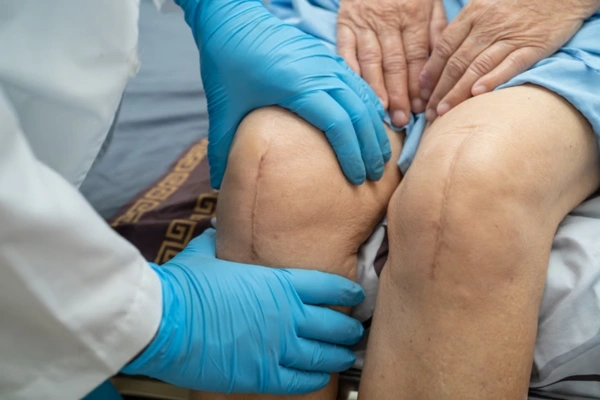
Patient Case #1
Patient Overview
| Detail | Information | |
| Patient | Ms. Chanderkala | |
| Age | 70 Years | |
| Gender | Female | |
| Surgery |
| |
| Surgeon |
|
Patient Story
Ms. Chanderkala, a 70-year-old female, was experiencing significant knee problems that affected her mobility and daily activities. As the condition progressed, the damage to both knee joints became more advanced, making normal movement increasingly difficult.
A detailed clinical assessment along with pre-operative X-rays showed severe degenerative changes in both knees, including significant narrowing of the joint spaces. Based on her symptoms, clinical findings, and the extent of joint damage, bilateral Total Knee Replacement was performed to address the damaged knee joints and help improve pain, stability, and mobility.
Before Surgery (Pre-operative X-ray)
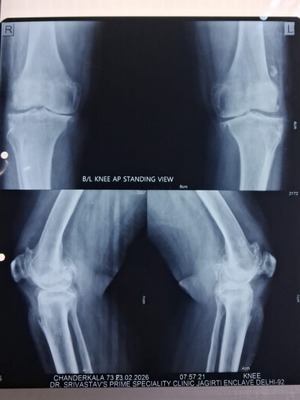
Patient: Ms. Chanderkala | Age: 70 Years | Gender: Female
The pre-operative X-ray of Ms. Chanderkala, a 70-year-old female, showed advanced degenerative changes in both knee joints, including significant joint-space narrowing and signs of severe joint wear. These findings were consistent with her knee symptoms and reduced mobility.
Based on her clinical evaluation, symptoms, and X-ray findings, bilateral Total Knee Replacement surgery was recommended to address the damaged joint surfaces and improve knee function and mobility.
After Surgery (Post-operative X-ray)
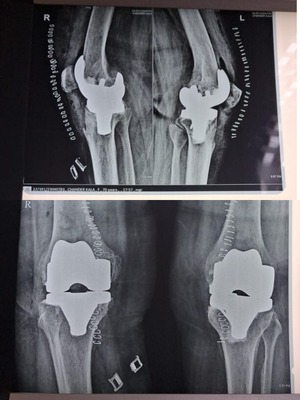
Patient: Ms. Chanderkala | Age: 70 Years | Surgery: Bilateral Total Knee Replacement
The post-operative X-ray of Ms. Chanderkala shows prosthetic components in both knee joints following bilateral Total Knee Replacement. The X-ray provides a clear comparison with the advanced joint degeneration seen before surgery and demonstrates the placement of the knee replacement components.
Following surgery, her recovery involved structured rehabilitation, physiotherapy, strengthening exercises, and gradual mobility training to support restoration of knee function and return to everyday activities.
Dr. Shekhar Shrivastav's Expert Insight
Every knee replacement case requires an individual approach based on the patient’s symptoms, joint damage, mobility, medical history, and functional goals.
For patients with advanced knee arthritis affecting both knees, bilateral Total Knee Replacement may be considered when conservative treatment no longer provides adequate relief and daily activities are significantly affected.
Careful evaluation, appropriate surgical planning, post-operative monitoring, and structured rehabilitation are important for supporting recovery and helping patients return to greater mobility and independence.

Ready to Take the Next Step Towards Better Knee Health?
Constant knee pain, stiffness, and difficulty walking can significantly affect your everyday life. If your symptoms are affecting your mobility or quality of life, an orthopedic evaluation can help determine the cause and identify suitable treatment options.