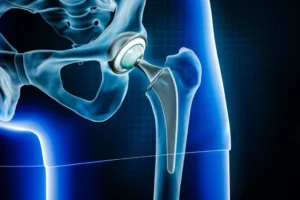

Hip pain can make walking, climbing stairs, sitting, or even sleeping difficult. When arthritis, a fracture, or another condition severely damages the hip and non-surgical treatments no longer provide enough relief, hip replacement may be recommended.
One crucial decision during hip replacement is how the implant will be fixed to the bone. In a cemented hip replacement, bone cement is used to secure the femoral component inside the thigh bone.
But is cemented fixation better than an uncemented implant? Who usually needs it, and what are the possible risks?
This complete guide explains cemented hip replacement, its benefits, risks, recovery, cost considerations, and how it compares with uncemented fixation.
What Is Cemented Hip Replacement?
Cemented hip replacement is a form of total hip arthroplasty where surgical bone cement is used to bond the femoral stem and acetabular components directly to the patient’s bone — creating a secure, immediately stable artificial hip joint.
The cement used — polymethylmethacrylate (PMMA) — is not an adhesive in the traditional sense. It works by filling the microscopic gaps between the implant and the bone surface, creating an interlocking mechanical bond as it sets. This bond is strong, immediate, and does not rely on the body’s own bone-forming cells to integrate with the implant over time.
This is the fundamental distinction that makes cemented hip arthroplasty the preferred approach for specific patient groups — particularly older adults and those whose bone quality makes natural bone in-growth unreliable.
What’s Special About Cemented Hip Arthroplasty?
The technique has been used for over 50 years — making it one of the most extensively studied surgical procedures in orthopaedic history. This track record is genuinely significant: no other hip fixation method has the same volume of long-term outcome data supporting it.
Key clinical advantages that set cemented hip replacement apart:
- Immediate fixation — the hip joint is stable and weight-bearing ready from the moment surgery is complete
- Bone quality independence — effective in patients with osteoporosis or poor trabecular bone where press-fit cementless designs may not anchor reliably
- 50+ years of outcome data — the longest and most robust evidence base of any hip replacement fixation method
- Lower revision risk in the elderly — in patients over 75, cemented fixation consistently outperforms cementless designs in long-term registry data
- Technically adaptable — can accommodate irregular bone anatomy where standard cementless press-fit sizing is difficult
Who Requires Cemented Hip Replacement?
Not every hip replacement patient is the same candidate. Cemented hip arthroplasty is specifically indicated for particular clinical presentations where its immediate fixation advantage is most valuable.
Primary candidates for cemented hip replacement include:
- Elderly patients (70+) — particularly those aged 75 and above, where bone density has declined sufficiently to make cementless press-fit fixation less reliable
- Patients with osteoporosis — where reduced bone density creates a risk of implant subsidence with cementless designs
- Patients with poor bone quality — assessed on CT or DEXA scan pre-operatively, confirming inadequate trabecular structure for biological fixation
- Patients with complex bone anatomy — where irregular canal geometry prevents accurate cementless component sizing
- Patients with femoral neck fractures — particularly displaced fractures in older adults requiring hemiarthroplasty or total hip replacement
Patients for whom cemented hip replacement may be less appropriate:
- Younger, active patients (under 60) with good bone density — where cementless fixation offers better long-term biological integration
- Patients with known PMMA allergy (rare but must be screened pre-operatively)
- Specific revision surgery cases where cement removal adds surgical complexity
Cemented vs Uncemented Hip Replacement — Which One Is Best?
This is the question most patients and families ask — and the honest answer is that neither is universally better. The right fixation depends entirely on the individual patient’s age, bone quality, anatomy, and activity demands.
| Feature | Cemented Hip Replacement | Uncemented Hip Replacement |
| Fixation method | Bone cement (PMMA) | Biological bone in-growth |
| Immediate stability | Excellent — from Day 1 | Develops over 6-12 weeks |
| Best bone quality | Works in any bone quality | Requires good bone density |
| Best patient age | 70+ and elderly patients | Under 60-65, active patients |
| Recovery timeline | Full weight-bearing Day 1 | Weight-bearing may be restricted early |
| Long-term revision risk | Lower in elderly patients | Lower in younger, active patients |
| Cement-related risks | Bone cement implantation syndrome (rare) | None |
| Registry evidence (elderly) | Superior | Inferior in low bone density |
| Cost in India | Lower | Higher (larger implant) |
The bottom line: For patients over 70 or those with osteoporosis, cemented hip arthroplasty consistently produces better long-term outcomes than cementless designs. For younger, more active patients with healthy bone, the reverse applies.
Benefits of Cemented Hip Replacement
For the right patient, cemented hip arthroplasty offers a compelling clinical benefit profile:
- Immediate weight-bearing — most patients stand and begin walking within 24 hours of surgery, without any restriction on loading the operated hip
- Bone quality independent — effective in osteoporotic bone where cementless implants would carry a subsidence risk
- Largest long-term evidence base — 50+ years of published data supporting safety and durability
- Lower revision rates in the elderly — major national joint registries consistently confirm superior outcomes in patients over 75
- Adaptable to irregular anatomy — the cement mantle fills irregular canal geometry that would prevent accurate cementless sizing
- Cost advantage — generally less expensive than cementless implants, particularly relevant in the Indian healthcare context
- Reduced risk of peri-prosthetic fracture at implantation — particularly relevant in fragile osteoporotic bone where press-fit insertion can crack the femur
Risks of Cemented Hip Replacement
Informed consent for cemented hip arthroplasty requires honest communication of its specific risks — separate from those shared with all hip replacement procedures.
Cemented hip replacement-specific risks:
- Bone cement implantation syndrome (BCIS) — the most significant cement-specific risk; occurs during or immediately after cement insertion as a result of embolic events, fat or monomer embolism, and cardiovascular response. Managed with careful anaesthetic monitoring and technique optimisation
- Cement mantle fracture — over time, the cement layer can crack — particularly in younger, more active patients — leading to implant loosening
- Difficult revision — removing cemented components at revision surgery is more technically demanding than extracting press-fit cementless stems
- Heat generation during setting — cement generates heat as it sets; managed by surgeons using appropriate technique
General surgical risks shared with all hip replacements:
- DVT (deep vein thrombosis) and pulmonary embolism — managed with anticoagulation and early mobilisation
- Surgical site infection
- Dislocation — more common in the posterior approach; managed with hip precautions
- Leg length discrepancy
- Nerve injury — rare in experienced hands
Cemented Hip Replacement Cost in India
Cemented hip replacement is generally more affordable than cementless alternatives — reflecting lower implant component costs and shorter operative time in many cases.
| Procedure | Estimated Cost in India |
| Cemented THA (Indian implant) | ₹1,20,000 – ₹2,20,000 |
| Cemented THA (Imported implant) | ₹2,00,000 – ₹3,50,000 |
| Cemented Hemiarthroplasty | ₹80,000 – ₹1,80,000 |
Factors affecting final cost:
- Hospital category — government, private tier-2, or corporate super-specialty
- Implant brand — Indian versus premium imported
- Surgeon experience and fee
- Hospital stay duration and post-operative rehabilitation
Most health insurance policies in India cover cemented hip replacement under standard surgical policies — verify implant sub-limits and request pre-authorisation before scheduling.
Recovery After Cemented Hip Replacement
One of the most significant practical advantages of cemented hip arthroplasty is the faster, less restricted early recovery compared with cementless designs.
| Phase | Timeframe | Key Milestones |
| Hospital stay | Day 1-3 | Walking with aid within 24 hours |
| Early home recovery | Week 1-4 | Walker use, wound care, gentle exercises |
| Active recovery | Week 4-8 | Cane use, increasing independence |
| Functional recovery | Month 2-3 | Driving cleared, daily independence |
| Full recovery | Month 3-5 | Complete function for most elderly patients |
Recovery is faster in cemented hip replacement because immediate cement fixation means full weight-bearing is allowed from Day 1 — unlike cementless designs where restricted weight-bearing may be required for 6-12 weeks while bone in-growth develops.
Critical recovery principles:
- Hip precautions for 6-12 weeks — avoiding flexion, adduction, and internal rotation combinations that risk dislocation
- Anticoagulants prescribed without skipping — DVT prevention is important
- Physiotherapy from Day 1 — mobilisation within 24 hours is standard protocol
- All follow-up appointments attended — X-ray review at 6 weeks confirms cement mantle integrity
Frequently Asked Questions
1. What is the difference between cemented and uncemented hip replacement?
Cemented hip replacement uses bone cement (PMMA) to immediately bond the implant to the bone — providing instant stability. Uncemented hip replacement relies on a rough, porous implant surface that allows biological bone ingrowth over 6-12 weeks for fixation. Cemented is preferred for elderly or osteoporotic patients; cementless for younger patients with good bone density.
2. How long does it take for cement to set in a hip replacement?
Surgical bone cement (PMMA) begins setting within approximately 8-12 minutes of mixing and reaches full mechanical strength within 24 hours. Surgeons work during the cement’s handling phase — typically 4-8 minutes — to ensure accurate implant positioning before the cement hardens.
3. Which is better — cemented or cementless hip replacement?
Neither is universally better. Cemented hip replacement is superior for patients over 70 and those with osteoporosis — with lower revision rates and better long-term outcomes in this group confirmed by national joint registry data. Cementless is preferred for younger, active patients with good bone quality. The right choice depends on individual patient assessment.
4. How long do cemented hip replacements last?
With 50+ years of clinical data behind them, cemented hip replacements show excellent long-term durability. Most studies and national joint registries report 10-year survival rates of 90-95% and 15-20 year survival rates of 85-90% in appropriately selected patients. Advanced cement techniques and improved implant designs continue to extend these outcomes.
5. Does bone grow around a cemented hip replacement?
No — the mechanism of cemented hip replacement is mechanical interlocking, not biological bone in-growth. The cement fills the gaps between the implant and the bone surface, setting into a hard material that bonds mechanically with the bone’s irregular surface. This is distinct from cementless implants, which have porous surfaces designed specifically to encourage bone cell in-growth.
Conclusion
Cemented hip replacement is one of the most well-established and evidence-supported procedures in advanced orthopaedic surgery — particularly for elderly patients and those with reduced bone density. It delivers immediate joint stability, reliable long-term fixation in the right patient group, and a faster, less restricted early recovery than cementless alternatives.
The most crucial factor in achieving the best outcome from cemented hip arthroplasty is accurate patient selection — ensuring the fixation method genuinely matches the individual’s bone quality, age, and functional goals.
Prime Ortho — Best Orthopedic Hospital in East Delhi — provides comprehensive hip replacement evaluation, including cemented, cementless, and hybrid fixation options, under the expert care of experienced joint replacement surgeons committed to the most appropriate, evidence-based choice for every patient.

Dr.Shekhar Srivastav
Robotic Joint Replacement Surgeon | Senior Orthopaedic Surgeon | Knee, Shoulder & Sport Injury Specialist