
THR, or Total Hip Replacement, is a surgical procedure that replaces affected parts of the hip joint with artificial components. It is commonly considered when severe hip pain, stiffness, and reduced mobility significantly affect daily life, and other treatments have not provided enough relief.
For someone considering hip replacement, questions about the procedure, preparation, recovery, and long-term results are natural.
This complete guide explains what THR involves and what patients can generally expect before, during, and after surgery.
What Is THR (Total Hip Replacement)?
THR — Total Hip Replacement, also called total hip arthroplasty — is a surgical procedure in which all affected surfaces of the hip joint are replaced with artificial implant components. Unlike partial hip replacement (hemiarthroplasty), which replaces only the femoral head, THR addresses both sides of the joint — providing the most comprehensive and durable solution for end-stage hip joint disease.
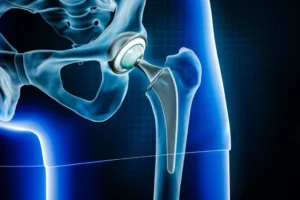
A complete total hip replacement system consists of four components working together:
- Femoral stem — implanted into the femoral canal; the anchor of the entire construct; titanium alloy in most advanced systems
- Femoral head — the artificial ball attached to the stem; ceramic, oxidised zirconium, or cobalt-chromium depending on bearing choice
- Acetabular shell — the outer cup fixed into the reamed pelvis; titanium for biological bone in-growth in cementless systems
- Acetabular liner — the bearing surface inside the shell; highly crosslinked polyethylene, ceramic, or ceramic-on-ceramic depending on patient age and activity level
When these four components are correctly sized, positioned, and balanced, the result is a hip joint that moves smoothly, bears full body weight, and — in the right patient — functions comfortably for 15-25 years.
5 Common Causes of Severe Hip Damage Requiring THR
THR is indicated when the hip joint has deteriorated to a level where daily function is significantly impaired and conservative management — physiotherapy, medication, injections — no longer provides adequate relief.
Cause 1 — Advanced Hip Osteoarthritis
The most common indication for THR globally. Progressive cartilage degeneration produces bone-on-bone contact, causing constant groin and anterior hip pain, morning stiffness, and progressive loss of walking capacity. X-ray shows Grade 3-4 joint space narrowing with subchondral sclerosis and osteophyte formation.
Cause 2 — Rheumatoid Arthritis of the Hip
Autoimmune joint destruction erodes both the femoral head and acetabulum simultaneously, often producing bilateral hip involvement in younger patients. THR in rheumatoid arthritis must account for reduced bone quality, systemic medication considerations, and potentially bilateral surgical planning.
Cause 3 — Avascular Necrosis (AVN) of the Femoral Head
When the femoral head loses its blood supply — from steroid use, alcohol, trauma, or systemic disease — bone death leads to femoral head collapse. Stage 3-4 AVN with joint space loss and secondary acetabular damage is a strong indication for THR rather than joint-preserving surgery.
Cause 4 — Post-Traumatic Hip Arthritis
Joint deterioration following hip fractures, acetabular fractures, or hip dislocations — often developing years after the original injury. The altered joint mechanics from previous trauma frequently require THR rather than simpler partial procedures.
Cause 5 — Hip Dysplasia with Secondary Arthritis
Structural abnormality of the hip socket — present since birth or childhood — causes abnormal joint loading and premature cartilage failure. THR in dysplastic hips often requires additional technical complexity, including acetabular augmentation or femoral shortening.
Symptoms That May Indicate You Need THR
THR is considered when these symptoms significantly limit daily life and have not responded to sustained conservative management:
- Chronic groin and anterior hip pain — constant at rest, severe with weight-bearing
- Severely limited walking distance — less than 15-20 minutes on flat ground before significant pain
- Hip stiffness limiting daily tasks — difficulty putting on shoes, socks, or getting into a car
- Night pain consistently disturbing sleep
- Inability to climb stairs without significant pain
- Failure of physiotherapy and NSAIDs to provide adequate sustained relief
- X-ray evidence of Grade 3-4 joint space narrowing — bone-on-bone contact confirming end-stage disease
How to Prepare for THR (Total Hip Replacement)
Preparation for THR significantly influences surgical outcomes and recovery speed. A structured pre-operative programme includes:
Medical optimisation:
- Cardiovascular assessment — ECG, echo, and cardiology clearance for patients over 60 or with cardiac history
- Blood sugar control — target HbA1c below 7.5 in diabetic patients to reduce infection risk
- Anaemia management — haemoglobin optimisation to reduce transfusion requirement
- Medication review — anticoagulant and immunosuppressant adjustment protocols
Prehabilitation:
- Quadriceps and hip abductor strengthening 4-8 weeks pre-operatively
- Aerobic conditioning to improve post-operative recovery capacity
- Weight management — even 5% body weight reduction meaningfully reduces surgical risk and post-operative load
Home preparation:
- Install grab rails in the bathroom and near the toilet
- Arrange ground-floor sleeping if stairs are an issue
- Organise post-discharge support — transportation, meals, caregiver availability
- Acquire walking aids (frame, crutches) before admission
THR Procedure — Step by Step
Understanding what happens during total hip replacement reduces pre-operative anxiety and sets realistic post-surgical expectations.
Anaesthesia: Spinal anaesthesia is the most commonly used approach — the patient is awake, but the lower body is numbed. General anaesthesia is used in specific cases based on patient preference and anaesthetic assessment.
Surgical approach: The most commonly used approaches are posterior (Moore), anterolateral (Watson-Jones), and direct anterior (DAA):
- Posterior approach: Most widely performed globally; excellent joint visualisation; slightly higher early dislocation risk managed with posterior capsule repair
- Direct anterior approach: Muscle-sparing; lower early dislocation risk; faster functional recovery; requires specific positioning equipment and surgical experience
Surgical steps:
- Skin incision over the hip using the selected approach
- Hip joint exposed and dislocated
- Femoral neck osteotomy — removing the femoral head
- Acetabular preparation — reaming the socket to accept the acetabular shell
- Acetabular shell insertion — press-fit cementless or cemented based on bone quality
- Acetabular liner seated within the shell
- Femoral canal preparation by sequential broaching
- Femoral stem insertion — press-fit cementless or cemented
- Trial reduction — checking leg length, offset, and joint stability
- Final components seated; hip reduced
- Wound closure and dressing
Operative duration: 60-90 minutes for primary THR in experienced hands.
Recovery After THR — Timeline and Milestones
| Phase | Timeframe | Key Milestones |
| Hospital stay | Day 1-3 | Walking with aid within 24 hours; pain management; physiotherapy begins |
| Early home recovery | Week 1-4 | Walker use; wound care; daily physiotherapy exercises |
| Active recovery | Week 4-8 | Transition from walker to cane; increasing independence |
| Functional recovery | Month 2-3 | Independent walking; driving clearance; return to light work |
| Full recovery | Month 3-6 | Complete daily function; low-impact sport resumption |
Critical recovery principles:
- Hip precautions for 6-12 weeks — avoiding the dislocation-risk position (flexion >90°, adduction, internal rotation)
- DVT prevention — anticoagulant medication taken without missing doses for 4-6 weeks
- Physiotherapy compliance — every session contributes to range of motion and strength milestones
- All follow-up appointments — X-ray review at 6 weeks confirms component positioning
Benefits of THR (Total Hip Replacement)
For appropriately selected patients, THR delivers outcomes that consistently justify the surgical investment:
- Complete elimination of chronic hip pain — the primary outcome; most patients report their pre-surgical chronic pain is significantly improved within 6-8 weeks
- Restored walking capacity — from severely limited to full community walking within 3 months
- Improved daily independence — dressing, bathing, climbing stairs, entering and exiting vehicles
- Better sleep quality — elimination of nighttime hip pain that disrupts sleep
- Long implant lifespan — Advanced THR implants show 90%+ survival at 15-20 years in national joint registry data
- Improved psychological wellbeing — reduced pain and restored independence consistently improve mood, social participation, and quality of life
- Return to low-impact activity — swimming, cycling, golf, and walking are actively encouraged after full recovery
Risks of THR (Total Hip Replacement)
Informed consent for THR requires honest discussion of risks — which, in experienced hands, occur at low rates:
Serious but uncommon risks:
- DVT and pulmonary embolism — the most important immediate risk; managed with anticoagulation and early mobilisation
- Peri-prosthetic infection — approximately 1% risk; higher in diabetic and immunocompromised patients; managed with antibiotic prophylaxis and meticulous surgical technique
- Dislocation — posterior approach carries the highest early risk; managed with hip precautions and posterior capsule repair
Less serious, more common issues:
- Leg length discrepancy — minor differences are common; significant discrepancy is minimised through careful pre-operative templating
- Heterotopic ossification — ectopic bone formation reducing range of motion; more common after trauma and in patients with prior hip surgery
- Implant loosening — the primary long-term failure mechanism; lower with advanced cementless fixation and correct sizing
- Revision surgery — required in approximately 5-10% of THR patients at 15-20 years; technically more complex than primary surgery
Frequently Asked Questions
1. What Is THR in Medical Terms?
THR stands for Total Hip Replacement, also called total hip arthroplasty. It replaces the affected ball and socket of the hip joint with artificial components to reduce pain and improve movement.
2. What Are the Signs That You Need THR?
Constant hip pain, difficulty walking, stiffness, reduced daily function, and symptoms that continue despite appropriate non-surgical treatment may indicate that hip replacement should be considered. Imaging and clinical evaluation help determine whether THR is appropriate.
3. How Long Does THR Surgery Take?
Primary total hip replacement commonly takes around 1–3 hours, depending on the patient’s condition and surgical complexity. The overall time in the operating and recovery areas is longer because of anesthesia preparation and post-operative monitoring.
4. What Can You Never Do Again After Total Hip Replacement?
There is no single activity that every patient must permanently avoid. High-impact activities may be discouraged, particularly during recovery, while restrictions such as avoiding extreme hip positions depend on the surgical approach and your surgeon’s advice.
5. What Is the Best Age for a Hip Replacement?
There is no specific “best age” for THR. The decision depends on joint damage, pain, functional limitations, overall health, and response to other treatments, rather than age alone.
Conclusion
THR is a well-established and widely performed procedure for patients with severe hip joint damage. It can significantly reduce pain, improve mobility, and help patients return to greater independence in daily life.
Outcomes depend on factors such as patient selection, surgical technique, implant choice, and post-operative rehabilitation, making appropriate evaluation and follow-up important throughout the treatment process.
Prime Ortho — Best Orthopedic Hospital in Delhi NCR — provides comprehensive THR evaluation, advanced surgical options including robotic-assisted techniques, and structured post-operative rehabilitation for patients across Delhi NCR.

Dr.Shekhar Srivastav
Robotic Joint Replacement Surgeon | Senior Orthopaedic Surgeon | Knee, Shoulder & Sport Injury Specialist