
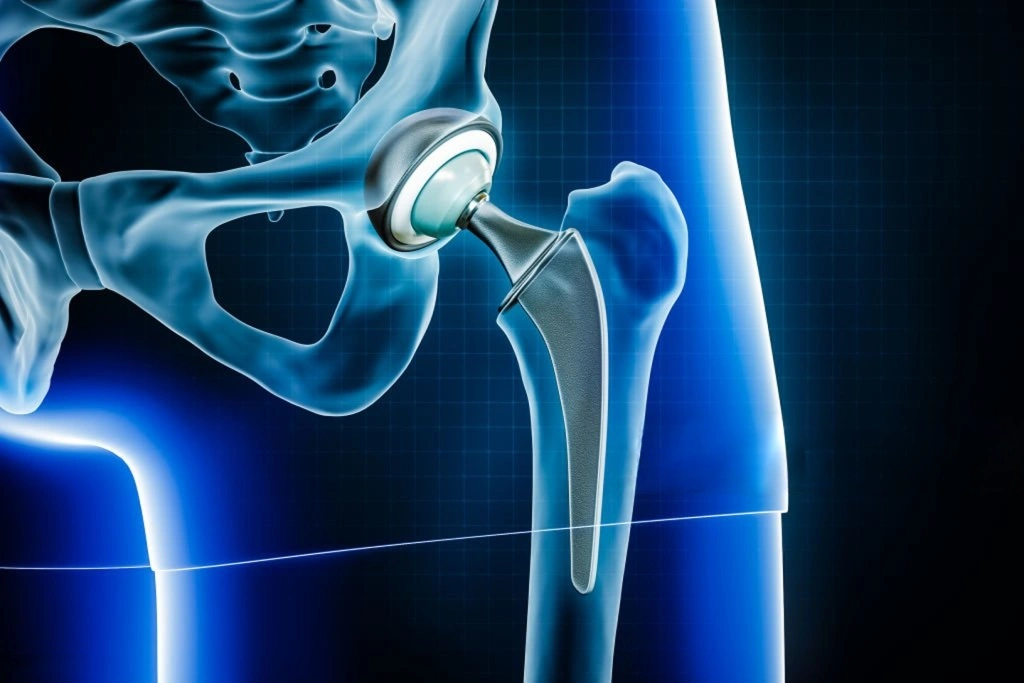
Hip pain can make daily activities such as walking, climbing stairs, sitting, or sleeping difficult. When severe hip damage does not improve with non-surgical treatment, hip replacement may be recommended to reduce pain and restore mobility.
A hip prosthesis, also called a hip implant, replaces affected parts of the natural hip joint. Different implants use different materials, designs, and methods of fixation. The most suitable option depends on factors such as bone quality, age, activity level, overall health, and the condition of the hip joint.
Understanding the different hip prosthesis types can help you have a more informed discussion with your orthopedic surgeon. However, implant selection should always be individualized rather than based on age or material alone.
What Is a Hip Prosthesis?
A hip prosthesis is an artificial joint system designed to replicate the function of a healthy hip — replacing the ball (femoral head) and socket (acetabulum) that have been damaged by arthritis, fracture, or other conditions causing severe pain and loss of mobility.
A standard total hip prosthesis consists of four main components:
- Femoral stem — implanted into the femur (thigh bone); the anchor of the entire system
- Femoral head — the artificial ball that replaces the affected femoral head; attaches to the top of the stem
- Acetabular shell — the cup component fixed into the pelvis, replacing the natural socket
- Acetabular liner — the inner bearing surface inside the shell that the femoral head moves against
Each of these components can be made from different materials — and the combination chosen for your surgery determines the implant’s wear rate, longevity, and suitability for your specific age, weight, and activity level.
Material Types of Hip Prosthesis — What They Are Made Of
The material combination — particularly the bearing surfaces where the ball and liner contact each other — is the most crucial specification decision in hip prosthesis selection.
Metal Components — Femoral Stem and Acetabular Shell
Titanium alloy (Ti-6Al-4V) is the most commonly used material for femoral stems and acetabular shells because:
- Excellent biocompatibility — the body tolerates titanium extremely well
- Highly porous coating options allow natural bone ingrowth for cementless fixation
- Lightweight — approximately 40% lighter than cobalt-chromium
- Minimal MRI artefact — important for post-surgical imaging
Cobalt-chromium alloy (CoCr) is used for femoral stems in cemented designs and for femoral heads because:
- Extremely hard and wear-resistant surface
- Higher strength-to-weight ratio than titanium for head components
- Long clinical track record — used in hip prostheses for 50+ years
Bearing Surface Types — Where the Science Matters Most
The bearing surface is the interface between the femoral head and the acetabular liner — and it is the primary determinant of how long a hip prosthesis lasts.
Metal-on-Polyethylene (MoPE):
The most widely used bearing combination globally — cobalt-chromium femoral head articulating against a standard or highly crosslinked polyethylene (HXLPE) liner.
- Standard PE: Higher wear rate — largely replaced by HXLPE
- HXLPE: 40-60% lower wear than standard PE — current gold standard for most patients
- Most appropriate for: Older, lower-demand patients; excellent safety profile
Ceramic-on-Polyethylene (CoPE):
Ceramic femoral head against HXLPE liner — zero metal ion risk combined with the proven durability of highly crosslinked polyethylene.
- No metal sensitivity risk
- Lower wear than CoCr-on-PE
- Most appropriate for: Patients with metal sensitivity; excellent long-term wear profile
Ceramic-on-Ceramic (CoC):
Both the femoral head and acetabular liner are ceramic — the lowest wear rate of any currently available hip bearing.
- Ultra-low wear particle generation
- Zero metal ion release
- Ceramic squeak occurs in 1-3% of cases
- Most appropriate for: Younger, more active patients requiring maximum longevity
Metal-on-Metal (MoM):
CoCr femoral head against CoCr liner — largely discontinued due to elevated cobalt and chromium ion release associated with adverse local tissue reactions and systemic metal ion toxicity.
- Now rarely used in primary hip replacement
- Existing MoM implants require ongoing monitoring
Oxidised Zirconium (Oxinium):
A metal core with a ceramic-like oxidised surface — combining metal toughness with ceramic wear resistance and no nickel content.
- Superior wear resistance compared to standard CoCr
- Suitable for patients with nickel allergy
- Most appropriate for: Active patients, nickel-sensitive patients
Hip Prosthesis Types by Fixation Method
Beyond bearing materials, hip prostheses are classified by how they anchor to the bone—and this choice is equally crucial in determining long-term outcomes.
Cemented Hip Prosthesis
Bone cement (polymethylmethacrylate — PMMA) bonds the prosthesis directly to the existing bone, providing immediate fixation stability from Day 1 of surgery.
Best for:
- Patients over 70 with reduced bone density
- Patients with osteoporosis
- Immediate full weight-bearing from Day 1
Cementless (Press-Fit) Hip Prosthesis
A porous or roughened implant surface allows the patient’s own bone cells to grow into the prosthesis over time — creating a biological bond.
Best for:
- Younger, more active patients (under 65) with good bone density
- Patients who want the longest possible implant-bone interface
- Maximum long-term fixation strength
Hybrid Hip Prosthesis
A cemented femoral stem combined with a cementless acetabular cup — combining the immediate stability of cement with the biological fixation advantage of a cementless socket.
Best for:
- Middle-aged patients with good acetabular bone but reduced femoral bone density
- Widely used in Europe with excellent long-term outcome data
Hip Prosthesis Specifications — Key Technical Details
Understanding these specifications helps patients ask the right questions before surgery:
| Specification | Options | Clinical Relevance |
| Femoral head size | 28mm, 32mm, 36mm, 40mm+ | Larger head = higher stability, higher liner wear |
| Femoral stem length | Standard, long, short (resurfacing) | Anatomy and bone quality dependent |
| Acetabular cup size | 48mm – 66mm (anatomy dependent) | Matched to pelvis dimensions |
| Neck length | Short, standard, long (+/- offset) | Leg length and soft tissue balance |
| Offset | Standard, high-offset | Hip abductor function and stability |
| Liner thickness | Varies by cup size | Thicker liner = more durable in larger patients |
These specifications are not chosen by the patient — they are determined by pre-operative templating using the patient’s X-ray and CT data — but understanding them helps explain the individualised nature of hip prosthesis selection.
Uses of Hip Prosthesis — When Is It Indicated?
A hip prosthesis is used when the hip joint has been affected beyond what any conservative treatment can effectively manage:
- Advanced osteoarthritis — bone-on-bone hip joint destruction causing constant pain
- Rheumatoid and inflammatory arthritis — systemic joint destruction affecting the hip
- Femoral neck fractures — particularly displaced fractures in elderly patients (hemiarthroplasty or total hip prosthesis)
- Avascular necrosis (AVN) — femoral head collapse due to disrupted blood supply
- Hip dysplasia — structural abnormality causing premature joint failure
- Post-traumatic arthritis — joint deterioration following previous hip injury or fracture
- Failed prior hip surgery — revision prosthesis required when a previous implant has failed
Preoperative Planning for Hip Prosthesis
Selecting the correct hip prosthesis requires structured, systematic pre-operative planning that considers the patient’s individual anatomy and medical profile.
Preoperative planning steps:
1. Clinical assessment:
- Age, activity level, functional goals, and life expectancy
- BMI — influences bearing surface and fixation method selection
- Medical comorbidities — diabetes, osteoporosis, cardiovascular status
2. Imaging templating:
- X-ray templating — measuring femoral canal width, acetabular dimensions, leg length difference
- CT scan — for complex anatomy, deformity, or revision cases
- DEXA scan — bone density assessment to confirm fixation method suitability
3. Implant selection:
- Based on age, activity level, bone density, and anatomy
- Bearing combination chosen to match anticipated activity demands and life expectancy
- Size verified against templating before surgery — reducing intraoperative adjustment
4. Surgical approach planning:
- Posterior, direct anterior, or lateral approach based on patient anatomy and surgeon expertise
- Each approach has different dislocation risk profiles and recovery implications
Warnings and Precautions for Hip Prosthesis
Patients considering hip prosthesis implantation should be aware of these important precautions:
Pre-implantation:
- Allergy testing — patients with known metal sensitivity should discuss ceramic or oxinium bearing options
- Active infection anywhere in the body — surgery must be deferred until infection is fully resolved
- Uncontrolled diabetes — significantly increases infection risk; HbA1c optimisation before surgery is important
- Anticoagulant medication — specific pre-operative adjustment protocol required
Post-implantation:
- Hip precautions — avoiding positions that risk dislocation (typically high hip flexion, internal rotation, and adduction combined) for 6-12 weeks
- Antibiotic prophylaxis before dental procedures — bacteria from dental work can seed a joint prosthesis; inform all treating dentists about your hip implant
- Metal-on-metal implant monitoring — if you received an MoM implant prior to widespread discontinuation, regular blood metal ion monitoring is required
- Activity modifications — running, high-impact sports, and jumping are discouraged to protect bearing surface longevity
Which Hip Prosthesis Type Is Right for You?
| Patient Profile | Recommended Prosthesis Type |
| Over 70, osteoporosis | Cemented stem + HXLPE liner, CoCr or ceramic head |
| 55-70, good bone density | Hybrid or cementless + ceramic-on-PE or CoC |
| Under 55, highly active | Cementless + ceramic-on-ceramic for maximum longevity |
| Metal allergy or sensitivity | Ceramic-on-PE or ceramic-on-ceramic, titanium stem |
| Femoral neck fracture, elderly | Cemented hemiarthroplasty (bipolar or unipolar) |
| Revision of failed implant | Revision stem system — case-specific selection |
FAQs
1. What is the best hip prosthesis?
There is no single best hip prosthesis for everyone. The choice depends on your age, activity level, bone quality, medical history, and lifestyle. Your orthopaedic surgeon will recommend the most suitable implant and bearing material for your needs.
2. How long will a prosthetic hip last?
Advanced hip prostheses can often last 15–25 years or longer with proper care. Longevity depends on factors such as implant type, activity level, body weight, bone quality, and overall health.
3. What is the cost of a hip prosthesis in India?
Hip prosthesis costs vary depending on the implant type and brand. In India, the prosthesis may range from approximately ₹1.2 lakh to ₹5 lakh or more, while the total surgery cost may also include hospital, surgeon, and anaesthesia charges.
4. How do surgeons choose the right hip prosthesis?
Surgeons consider X-rays or CT scans, bone quality, hip anatomy, age, body weight, activity level, and medical history. Implant size and type are then selected to achieve proper fit, stability, and leg length.
5. What are signs a hip implant is failing or worn out?
Possible signs include recurring hip pain, groin or thigh pain, instability, clicking, leg-length changes, or increasing difficulty walking. If these symptoms develop or worsen, an orthopaedic evaluation and imaging may be needed.
Conclusion
Hip prosthesis selection is not a one-size-fits-all decision — the right implant type, material combination, and fixation method for a 45-year-old active patient is entirely different from the right choice for a 78-year-old patient with osteoporosis. Getting this decision right — with thorough pre-operative planning and experienced surgical judgment — is what determines how long your hip replacement lasts and how well it performs throughout your life.
Prime Ortho — Best Orthopedic Hospital in East Delhi — offers comprehensive hip prosthesis evaluation and advanced hip replacement surgery, including the full range of cemented, cementless, hybrid, and ceramic bearing options — with meticulous pre-operative templating and experienced joint replacement surgeons guiding every implant selection decision.

Dr.Shekhar Srivastav
Robotic Joint Replacement Surgeon | Senior Orthopaedic Surgeon | Knee, Shoulder & Sport Injury Specialist