Recovering after hip replacement surgery takes time, patience, and the right rehabilitation plan. Hip replacement exercises can help improve muscle strength, joint movement, balance, and confidence as you return to daily activities.
However, not every exercise is suitable immediately after surgery. Your orthopaedic surgeon or physiotherapist will guide you on when to begin, how many repetitions to perform, and which movements to avoid based on your procedure and recovery progress.
Understanding Hip Replacement Exercises
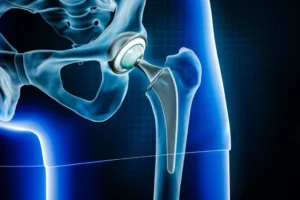
Hip replacement exercises are movements prescribed by your orthopaedic surgeon or physiotherapist to begin after surgery and progress gradually throughout recovery. They help rebuild strength, improve mobility, and support safe movement.
After total hip replacement (THR), muscles around the joint, including the gluteal and quadriceps muscles, may be weakened. Targeted exercises help restore muscle function, improve stability, support circulation, and make daily activities easier.
This complete guide covers exercises commonly used from the early post-operative stage through active recovery. The timing and suitability of each exercise depend on your surgical approach and your care team’s instructions.
Why Exercise Is Essential After Hip Replacement Surgery
Many patients assume that rest is what heals the hip after surgery. Rest protects the healing tissues — but it is exercise that rebuilds the function the surgery restored. Without progressive hip replacement exercises:
- Quadriceps and gluteal muscles weaken rapidly through disuse
- Swelling and joint stiffness increase without the pumping action of muscle contractions
- Deep vein thrombosis (DVT) risk rises when calf and leg muscles are inactive
- Gait abnormalities — limping patterns — become habitual and difficult to correct later
- The full range of motion gains from surgery are lost to scar tissue if not maintained
Walking with a frame within 24 hours of hip replacement surgery is standard protocol — and it should be followed by the progressive exercise programme below.
10 Best Hip Replacement Exercises for Recovery
Exercise 1 — Ankle Pumps
Ankle pumps are the first hip replacement exercise you will perform — starting while still in the hospital bed, typically within a few hours of surgery.
How to Perform Ankle Pumps:
- Lie flat on your back with legs extended
- Flex both feet toward you (pulling the toes upward) — hold for 2 seconds
- Point both feet away from you (pushing the toes downward) — hold for 2 seconds
- Perform 10-20 repetitions every hour during waking hours in the first week
Why Ankle Pumps Matter:
- Activate the calf muscle pump, pushing blood back up the leg and reducing DVT risk
- Reduce post-operative swelling in the foot and ankle
- Can be performed immediately — no hip precaution conflict
Exercise 2 — Quad Sets (Quadriceps Contractions)
Quad sets activate the quadriceps — the primary muscle group responsible for knee extension and hip stability during walking — without any joint compression or hip movement.
How to Perform Quad Sets:
- Lie on your back with legs straight
- Tighten the quadriceps of the operated leg by pressing the back of the knee down toward the bed
- Hold the contraction for 5 seconds, then relax
- Perform 10-15 repetitions, 3-4 times daily from Day 1
Why Quad Sets Matter:
- Maintain quadriceps activation during early recovery when active movement is restricted
- Prevent rapid muscle atrophy in the first post-operative week
- Prepare the leg for the weight-bearing required in standing and walking exercises
Exercise 3 — Heel Slides
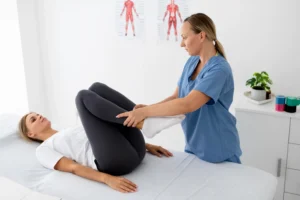
Heel slides introduce controlled hip flexion — gradually restoring hip movement within safe parameters during the first week of recovery.
How to Perform Heel Slides:
- Lie on your back, legs extended
- Slowly slide the heel of the operated leg toward you — bending the hip and knee
- Stop before hip flexion reaches 90 degrees — the key hip precaution limit
- Slide back to the starting position and repeat
- Perform 10-15 repetitions, twice daily
Why Heel Slides Matter:
- Gently restore hip flexor flexibility lost during early recovery
- Improve range of motion without loading the joint
- Maintain muscle memory for the hip flexion pattern needed in walking and sitting
Exercise 4 — Gluteal Squeezes
Gluteal squeezes target the gluteus maximus — the most powerful hip stabiliser and the primary muscle preventing hip instability during walking.
How to Perform Gluteal Squeezes:
- Lie flat on your back or sit upright in a chair
- Squeeze both buttocks together as firmly as comfortable
- Hold for 5 seconds, release, and repeat
- Perform 10-15 repetitions, 3-4 times daily from Day 1-2 onwards
Why Gluteal Squeezes Matter:
- Activate the posterior hip musculature without any joint movement or risk of precaution
- Essential preparation for the hip abductor and extension exercises introduced later
- Reduce the risk of the Trendelenburg gait pattern (pelvic drop) in early walking
Exercise 5 — Short Arc Quads
Short arc quads progress from quad sets to actual knee extension — loading the quadriceps through a short, safe arc of movement.
How to Perform Short Arc Quads:
- Lie on your back, place a rolled towel or blanket under the knee of the operated leg to support it at approximately 30-40 degrees
- Straighten the knee fully by lifting the foot off the bed — hold for 3-5 seconds
- Slowly lower the foot back to the towel
- Perform 10-15 repetitions, twice daily from Day 2-3
Why Short Arc Quads Matter:
- Significantly strengthen the quadriceps with minimal hip joint stress
- Improve the quadriceps force required for safe stair climbing — an early recovery milestone
- Build toward the loaded walking and standing exercises introduced in the following weeks
Exercise 6 — Standing Hip Abduction
Standing hip abduction targets the gluteus medius — the most crucial muscle for preventing the pelvis from dropping sideways during single-leg stance in walking.
How to Perform Standing Hip Abduction:
- Stand upright, holding a stable surface (chair back or wall) for support
- Slowly raise the operated leg out to the side — keeping the toes pointing forward
- Do not raise the leg above 45 degrees — maintain hip precautions
- Hold for 2-3 seconds at the top, lower slowly
- Perform 10-15 repetitions, once or twice daily from Week 1-2
Why Standing Hip Abduction Matters:
- Directly targets the gluteus medius, whose weakness produces the characteristic post-THR limp
- Improves lateral hip stability critical for safe walking on uneven surfaces
- Progresses safely from lying exercises to weight-bearing functional movements
Exercise 7 — Standing Hip Extension
Standing hip extension strengthens the gluteus maximus through a functional, weight-bearing position — mimicking the push-off phase of the walking gait cycle.
How to Perform Standing Hip Extension:
- Stand upright, holding a chair or stable surface for support
- Slowly move the operated leg backward — keeping the knee straight and the back upright
- Raise the leg approximately 15-20 degrees behind you — do not lean forward to compensate
- Hold for 2-3 seconds, return slowly to neutral
- Perform 10-15 repetitions, once daily from Week 2 onwards
Why Standing Hip Extension Matters:
- Rebuilds the hip extension needed for the push-off phase of normal walking
- Reduces the energy cost of walking by restoring normal gait mechanics
- Progresses from passive hip extension to active, loaded strength
Exercise 8 — Sit-to-Stand Practice
Sit-to-stand is one of the most functional and essential hip replacement exercises — because rising from a chair is one of the highest-demand daily movements the new hip encounters.
How to Perform Safe Sit-to-Stand:
- Sit near the front edge of a firm chair with both feet flat on the floor
- Slide the operated leg slightly forward — keeping the hip angle above 90 degrees
- Place both hands on the chair armrests and push up to standing — leading with the non-operated leg
- Reverse the process to sit — lower slowly and in control
- Practice this movement 5-10 times during each physiotherapy session
Why Sit-to-Stand Practice Matters:
- Restores functional independence for the single most common daily challenge post-THR
- Reinforces the hip precautions during transition from sitting to standing
- Strengthens quadriceps and gluteals under meaningful functional load
Exercise 9 — Stair Climbing (Step Ups)
Stair climbing is a key functional milestone — most patients need to navigate at least a few steps to access their home. Practising controlled step-ups prepares the hip and leg for this challenge.
How to Perform Safe Stair Climbing:
- Stand at the base of one step with a handrail available
- Step up with the non-operated (stronger) leg first — “good leg goes up first”
- Bring the operated leg up to join it
- To descend — lead with the operated leg first — “bad leg goes down first”
- Perform this exercise under physiotherapist supervision initially
Why Stair Climbing Matters:
- Restores essential functional independence for home access and daily life
- Builds eccentric quadriceps strength during the downstep phase
- The mnemonic “up with the good, down with the bad” makes this consistently teachable
Exercise 10 — Walking Programme
Structured, progressive walking is the most important single hip replacement exercise for long-term recovery — and it begins on Day 1.
How to Progress the Walking Programme:
- Days 1-3: Short walks of 2-5 minutes with a walking frame — focusing on even weight distribution
- Week 1-2: Progress to 5-10 minute walks, 3-4 times daily with a frame or crutches
- Week 3-4: Advance to cane use as quadriceps and hip abductor strength allows
- Month 2+: Progressively increase distance — targeting 20-30 minutes of continuous walking by month 3
Why Progressive Walking Matters:
- Drives all aspects of functional recovery — cardiovascular health, joint mobility, muscle strength, and gait normalisation
- Reduces DVT risk through regular leg muscle pump activation
- Directly correlates with long-term quality of life outcomes in THR registry data
Benefits of Hip Replacement Exercises
A consistent hip replacement exercise programme produces measurable benefits across all dimensions of recovery:
- Faster return to independence — patients who exercise consistently from Day 1 achieve independent walking milestones 2-4 weeks earlier than those who rely on rest
- Reduced DVT risk — ankle pumps and regular walking dramatically reduce the risk of deep vein thrombosis in the post-operative period
- Improved implant stability — strong hip abductors and extensors provide the dynamic stability the prosthetic joint relies on
- Reduced swelling — muscle contractions act as a pump, reducing post-operative oedema more effectively than elevation alone
- Better long-term gait quality — targeted exercises prevent the compensatory limping patterns that become habitual when muscles are weak
- Lower revision risk — good muscle strength reduces the mechanical load on the implant components
Exercises to Avoid After Hip Replacement Surgery
Certain exercises and movements must be avoided during the recovery period to prevent dislocation:
- Deep squats — hip flexion beyond 90 degrees risks posterior dislocation
- Crossing the legs — adduction past neutral risks dislocation, particularly with posterior approach surgery
- Internal rotation exercises — rotating the operated leg inward is a primary dislocation risk position
- High-impact activities — running, jumping, and contact sports during the first 3-6 months
- Yoga positions involving deep hip flexion — pigeon pose, lotus, and deep forward folds are contraindicated during the precaution period
When to Contact Your Doctor or Physiotherapist
Resume your exercise programme cautiously and contact your care team if you notice:
- Sudden increase in hip pain during or after exercise — beyond typical post-exercise soreness
- Swelling that increases rather than decreases with exercise
- A clicking, clunking, or grinding sensation in the hip joint during movement
- The hip feeling loose or unstable during weight-bearing exercises
- Calf pain, redness, or swelling — possible DVT requiring urgent evaluation
- Fever or increasing wound redness — possible infection
Do not push through sharp pain during hip replacement exercises. There is a clear difference between the mild muscle fatigue of progressive exercise and the warning pain of a potential complication.
Frequently Asked Questions
1. What is the best exercise for hip replacement recovery?
Walking is a crucial part of recovery because it helps rebuild mobility and walking patterns. Ankle pumps, gluteal squeezes, and standing hip abduction may also help, depending on your recovery stage and physiotherapist’s guidance.
2. What can you never do again after total hip replacement?
Many patients return to walking, swimming, cycling, and other activities. High-impact sports may be discouraged to protect the implant. Some patients also need specific movement precautions, depending on the surgical approach and their surgeon’s advice.
3. What is the fastest way to recover from a hip replacement?
Follow your rehabilitation plan, begin movement when medically cleared, exercise consistently, eat a balanced diet with adequate protein, take prescribed medicines, and attend follow-up appointments. Recovery varies from person to person.
4. What are the top 5 mistakes to avoid after hip replacement?
Common mistakes include ignoring movement precautions, crossing the legs when restricted, increasing activity too quickly, skipping prescribed physiotherapy, and missing follow-up appointments. Follow your surgeon’s individual instructions.
5. How much bed rest is required after hip replacement?
Prolonged bed rest is generally discouraged. Many patients begin supported standing and walking within 24 hours when medically cleared. Your care team will guide your activity level to support recovery and reduce complications such as blood clots.
Conclusion
Hip replacement exercises are not the part of recovery you do after healing — they are the mechanism through which healing becomes function. Starting on Day 1 and progressing consistently through each exercise phase is what transforms a successful surgical procedure into a genuinely transformed quality of life.
Prime Ortho — Best Orthopedic Hospital in Delhi NCR — provides comprehensive post-hip replacement physiotherapy and rehabilitation programmes, expert surgical care for total hip replacement, and structured exercise guidance to ensure every patient achieves the fastest, safest, and most complete recovery possible.

Dr.Shekhar Srivastav
Robotic Joint Replacement Surgeon | Senior Orthopaedic Surgeon | Knee, Shoulder & Sport Injury Specialist